Showing posts with label amalfi. Show all posts

Sunday, September 1, 2024

Sorrento


Sorrento is the perfect Amalfi coast town, with great streets to explore and good cuisine.  Piazza Tasso is the heart of town, spanning the ravine that divides new town (east) from old town (west), with great views of the Bay of Naples.  On the western side of the square is the main shopping street Corso Italia.  Great gelato at a Raki on Corso Italia.  

Ravine (old town on left)


Via Santa Maria dela Pieta is a tiny, ancient alley that runs parallel to the commercial Corso Italia, connecting Piazza Tasso and the cathedral.  Sorrento Cathedral is small but is noteworthy for the inlaid wood Stations of the Cross around the nave of the church.  There is an ornate nativity scene that places the manger in the topography of Sorrento (including the gorge), and all the people are dressed like Amalfians.  It’s an interesting local interpretation of the biblical story, and we saw similar nativity scenes in other Amalfi churches.  

Sorrento Cathedral bell tower

Sorrento Cathedral entrance

Sorrento Cathedral cloister


Inlaid-wood station of the cross

Nativity scene

Cathedral nave


We enjoyed wandering the old streets between Corsa Italia and the marina, with cute squares and lots of shops and restaurants.  Restaurant Zi Ntonio had nice atmosphere and good food.  The Villa Communale is a beautiful park overlooking the bay of Naples.  

Piazza d Vittoria

Via Giuliani in old town


The Basilica of St Anthony has a crypt with an incredibly ornate chapel, and hundreds of silver “votives” depicting the body parts that worshippers believe St Anthony healed.  

Basilica San Antonino nave

San Antonino votives

San Antonino crypt


Marina Grande has restaurants and beach.  Marina Piccolo has ferry service to Positano and Capri, easy to book tickets, run every hour more or less.  Multiple companies, two areas of ticket booths.  

Marina Piccolo


The Antiche Mura hotel is a great full-service hotel just one block from Piazza Taso (main square). Great breakfast, pool area with lemon trees.  It’s expensive, but everything is expensive in Sorrento.  There is a small grocery across the street, and a larger one east on Corso Italia from Piazza Taso.

We ate at Tavern Allegra, excellent service, great food.  The seafood mixed grille was delicious, the tagliatelle Bolognese was great, midnight kiss drink was awesome (slushy tequila, limoncello and prosecco).  Giuseppe host, friend owns Pepperoncini in Conshohocken.

View from Villa Comunale of Marina Piccolo
and Mt Vasuvius in the distance


Salerno


Castelle di Arche

Unlike the other Amalfi towns, Salerno did not feel like a tourist destination; rather, it seemed to be populated primarily with locals.  The waterfront area has a nice promenade along the Mediterranean.   The old town has narrow streets and arches connecting buildings as reinforcement.  The main shopping street in the old town is Via Merchanti, lined with shops and some restaurants (clearly catering to locals).  Via Botteghelle is a cute medieval street.  The town is a little grungy, similar to Palermo, but it has character.  Salerno dates from Etruscan times, but the Romans established the city.  Castelle di Arche, situated on the hilltop overlooking the city, was built in the 8th century when Salerno was ruled by the Byzantines after the fall of Rome.  Salerno was conquered by the Normans, who built an aqueduct in the 11th century, sections of which still exist.  The Spanish ruled Salerno from the 15th to the 18th century, when Salerno was brought into the unified Italy in 1861. 


Norman aqueduct


The most famous site to visit is the Duomo San Matteo (Cathedral of Saint Matthew), which contains the bodily remains of St Mark the apostle and disciple, which were discovered in the 10th century and moved to Salerno.  The Cathedral’s construction was started in 1076, after the Normans conquered Salerno, to house St Matthew’s remains.  The four-sided portico, in the shape of a courtyard, has relics and sarcophagi from the second and third century. 

Courtyard and bell tower

Brass Cathedral doors

Entrance to Cathedral courtyard


Suckling lion at the gate

St Matthew


The cathedral has an austere nave, whitewashed during an 18th century reconstruction.   There are several elements to the altar area that are beautiful, with inlaid tiles that look Arabic.  The mosaics above the altar are incredible – they were made by artisans from Ravenna as commissioned by William of Ravenna, the archbishop of Solerno in the 12th century (Tammy and I saw the Cathedral in Ravenna with mosaics that inspired these). 

Ravenna mosaic above altar

Nave and altar

Pulpit tiles


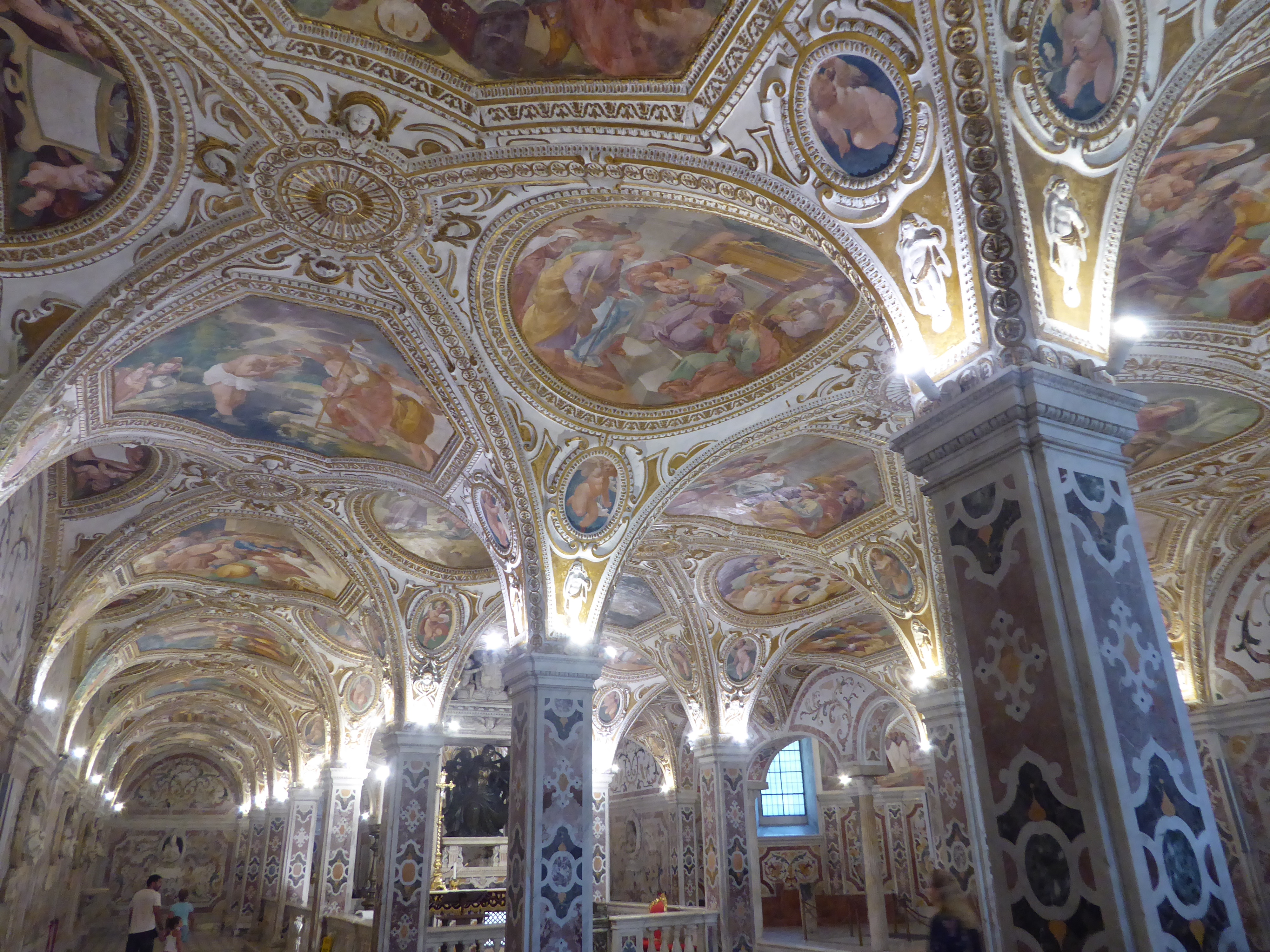
The crypt with the remains of St Matthew was amazing, incredibly ornate marble mosaics and frescoes on the walls and ceilings. 

St Matthew Crypt

St Matthew tomb (behind
circular window with cross)


The Church of St Peter in Chains is in the early phases of restoration.  The church was constructed in the 9th century on a foundation comprised of ancient Roman baths.  The Romanesque campanile (tower) was constructed in 920. 

St Peter in Chains tower

St Peter in Chains restoration

St Peter in Chains Christian fresco


In Salerno, we were introduced to the Taralli, a savory bagel-shaped biscuit with fennel and other spices served with wine.  They are served all over Amalfi and Tuscany, but none taste as good as the Salerno Taralli. 

Duomo San Matteo

Cathedral mosaic

Ave Maria mural

Norman aqueduct

Taralli


Saturday, August 31, 2024

Positano, Italy


Positano flourished in the 12th and 13th centuries, but was abandoned for fear of pirates, and was reborn in the 18th century.  The town sits on the site of a Roman villa complex that was buried when Mt Vesuvius erupted in 79 AD.  

There is no real town center in Positano, but lots of activity at the marina with beach clubs crowded with Italians on holiday.  The main street winds up the steep hillside, which is lined with shops.   Restaurant il Tridente has great views of Positano, but is overpriced (as is everything in Positano).  

Positano from il Tridente

Positano from the ferry

Positano marina


The Church of Santa Maria Assunta has iconic majolica tile roof.  Above the altar is the Black Madonna, a Byzantine painting from the 12th century.

Altar and Black Madonna

Santa Maria Assunta


We took the ferry to Positano but Traveled back to Sorrento from Positano via Sita bus was is cheap and easy, but must buy tickets at Tobbachi store near bus stop. 


Capri, Italy


Capri can be overwhelmed by tourists, so we took the first ferry from Sorrento in the morning to beat the crowds.  Upon arriving, we went immediately to Anacapri by taxi, it’s a fun ride for 35 Euros, the taxi stand is near the port terminal.  We were dropped off at Piazza Victoria (where the taxi stand for the return trip is located, and very near the Monte Solaro chairlift).  From Piazza Victoria we walked along Via Orlandi, which is a very cute pedestrian street with churches, shops, and cafes.  There are signs with historical information along the way, so it’s perfect for a self-guided tour. 

Anacapri Santa Sofia

Anacapri street


The Church of San Michele (pronounced "me kay lee" for Michael) Arcangelo is a must-see.  The Baroque church has an incredible, intricate majolica tile floor depicting Adam and Eve being cast from the Garden of Evil.  Look for the expressions on the animal faces.  This church is small but amazing and unique. 

San Michele domes

San Michele altar

San Michele tile floor


Casa Rosa is a small, quirky museum in the villa of a Swedish aristocrat, showcasing his lifetime collection of art.  It has a nice view of Anacapri and Mount Solaro from the rooftop terrace. Notice the “heat domes” on the roofs of the houses, typical in Amalfi (we saw them in Positano as well).  

View from Casa Rosa roof

Heat domes on roofs


View from Ville San Michele


Back at Piazza Vittoria, there is a path up the stairs and to the left lined with shops that leads to Villa San Michele and a great view down to Capri town.


Leaving Anacapri, we took a bus from Piazza Pache (less crowded than Piazza Vittoria) to Capri town.  Unlike the Sita buses, you buy the tickets on bus.  

Capri town centers around Piazza Umberto, with a medieval alley branching off to the left of the City Hall.  The clock tower is iconic, and the stairs down to the port located at the base of the tower.  The Cathedral has a marble floor that dates to Roman times.  Instead of the funicular, we walked down 15 minutes to the harbor via the steps from the clock tower.  

Clock Tower

View from Capri town

We took the Capri island boat tour, which includes the trip into the Blue Grotto (but not the entrance fee, which must be paid at the Grotto).  Unfortunately, the tide was too high so we could not enter.  I understand that more often than not, the grotto is closed due to high tides and rough water.  Circling the island was still a great experience – wear sunscreen and bring water!

Capri marina and Capri town

Emerald Grotto

Capri Faraglioni rock formations